Back to Blog
Stop Drowning in Spreadsheets: The Hidden Cost of Manual Ad Reporting
Joe Vanek
It's 4:47 PM on a Thursday, three days into the month. Your ad ops manager pings you on Slack: "Hey, still pulling last month's numbers. The Amazon export is taking forever, and I need to cross-reference three different partner portals. Might need until tomorrow."
You've seen this movie before. What started Monday as "quick monthly report" has consumed three full days. Your manager has browser tabs open for Google Ad Manager, Amazon Publisher Services, and at least a dozen other demand partners. They're logging into different UIs, downloading CSV files, copying numbers into Excel, and building pivot tables to consolidate everything into a format finance can actually use.
By the time the deck is ready for Monday's meeting, you'll be a week into the new month, making decisions based on data that's already ancient history.
This isn't just annoying.
Your Monthly Report Actually Costs $22,800 (And That's Just the Beginning)
Let's talk about the real price tag of manual reporting—because most publishers dramatically underestimate what they're actually spending.
The Direct Cost
Your ad ops manager pulling reports isn't free labor. At an $80-100K salary, you're paying roughly $1,900 per week. If monthly reporting consumes a full week (and let's be honest, it often does), that's $1,900 per month or $22,800 per year.
That's not a rounding error. That's a junior ad ops hire. Or a premium demand partner integration. Or attendance at ten industry conferences. You're spending the equivalent of an entry-level salary just to find out what happened last month.
The Opportunity Cost
Here's where it gets expensive. While your team compiles spreadsheets, here's what's NOT happening: testing new header bidding configurations, optimizing floor prices, analyzing timeout rates, improving Core Web Vitals, investigating revenue anomalies, or exploring new demand partnerships.
Industry data shows that publishers who optimize weekly rather than monthly see 12-18% revenue lifts. Let's do conservative math: if you're generating $5M in annual ad revenue, and better optimization could lift that by even 10%, you're leaving $500K on the table.
Your best revenue minds are doing data entry instead of driving revenue. Your optimization team is too busy reporting what happened to focus on improving what happens next.
The Decision Cost
By the time reports finally land on executive desks, you're 7-10 days into the new month. That underperforming bidder from last month? Still running at the same weight. That CPM spike on mobile you could have capitalized on? The window closed a week ago.
In digital advertising, where margins are tight and competition is fierce, every day of delay is revenue left on the table.
It's Not Your Team. It's Your Stack.
Before you blame your ad ops team for being slow, understand what they're actually dealing with.
The Scattered Data Problem
The modern publisher stack is a Frankenstein's monster of disconnected platforms. Your team needs to pull data from Google Ad Manager, Amazon Publisher Services, multiple demand partners, DSP relationships, Google Analytics, Prebid analytics, and various custom integrations.
Each platform has different metric definitions—what counts as an "impression" to Google might not match Amazon's definition. They offer data in different formats, use different UIs, and call the same thing by different names. One calls it a "placement," another an "ad unit," a third a "zone."
Your team isn't slow. They're translating between five different languages while trying to spot patterns in the noise—and they're doing it blind. Beyond the data format challenges, there's the operational complexity: remembering which demand partners send reports via email versus providing portal access, managing dozens of login credentials across platforms, navigating unfamiliar UIs to find the right report section, and recalling which partners update their data daily versus weekly. One team member knows where the Amazon reports live, another is familiar with the Google Ad Manager export process, but when someone's on vacation, the entire reporting cycle stalls.
The Human Error Tax
Manual reporting isn't just slow—it's error-prone. When your team is copying and pasting data across multiple platforms, mistakes happen. A misplaced decimal, a wrong date range, data from the wrong ad unit—these errors cascade into reports that leadership relies on for million-dollar decisions.
Then comes the real time sink: finding and fixing those errors. You present numbers to your CFO, someone questions a figure, and suddenly you're spending hours retracing steps through five different platforms to identify where the mistake occurred. With Exec as your single source of truth, you eliminate the copy-paste errors that come from manual data transformation. The numbers are pulled directly from SSPs, consistently and accurately, every time.
The Reconciliation Nightmare
When your revenue data lives in ten different places, every stakeholder question becomes a research project. Your CFO asks about last month's CPMs, but which number do you trust? GAM shows one figure, Amazon shows another, and individual SSPs each report their own version.
This isn't about reconciling normal variance—that's expected and useful for optimization. The real problem is you don't have a reliable, consistent foundation for executive reporting and billing. Exec solves this by becoming your authoritative source of truth, pulling billing-accurate numbers directly from SSPs. You're not guessing which platform's data to trust or manually stitching together reports from scattered sources. You have one unified view that everyone—from ad ops to finance to the C-suite—can confidently reference.
The Bottleneck Effect
Every stakeholder question requires an ad ops ticket. "What was our mobile CPM last week?" sounds simple but requires four hours of data pulling. Board deck needs updated numbers? Drop everything for two days.
Your executive team can't self-serve insights, which means ad ops becomes a reporting department instead of an optimization team. The people you hired to grow revenue spend their days being human APIs.
When Reporting Takes a Week, Everything Else Slows Down
The reporting bottleneck doesn't just waste time—it cascades through your entire organization.
Strategic Planning Suffers
You can't make data-driven decisions without current data. Quarterly planning is based on three-week-old trends that may no longer apply. Testing happens slowly because measuring results takes forever. Innovation stalls because if measurement is painful, teams avoid trying new things.
You end up making gut-feel decisions because getting the data is too hard.
Team Morale Craters
Your best ad ops talent didn't sign up to be Excel jockeys. They came to optimize revenue, solve complex technical challenges, and drive business impact. Instead, they're doing repetitive manual tasks that a script should handle.
High-value employees doing low-value work leads to burnout, and eventually, resignation letters. "They left for a company with better tooling" becomes a recurring exit interview theme.
Revenue Optimization Stops
Here's the cruel irony: when 40% of ad ops time goes to reporting, optimization gets 40% less attention. You're spending time proving what happened instead of improving what happens next. Reactive firefighting replaces proactive revenue growth.
You hired optimizers, but you're using them as calculators.
What If Your Reports Just... Showed Up?
Imagine a different Monday morning. At 8 AM, comprehensive performance reports land in your exec team's inbox—no requests, no delays, no "let me pull that data." Every stakeholder has the insights they need when they need them. Your ad ops team starts the week analyzing opportunities, not assembling spreadsheets.
This isn't about adding another dashboard. It's about automated intelligence delivery.
How It Actually Works
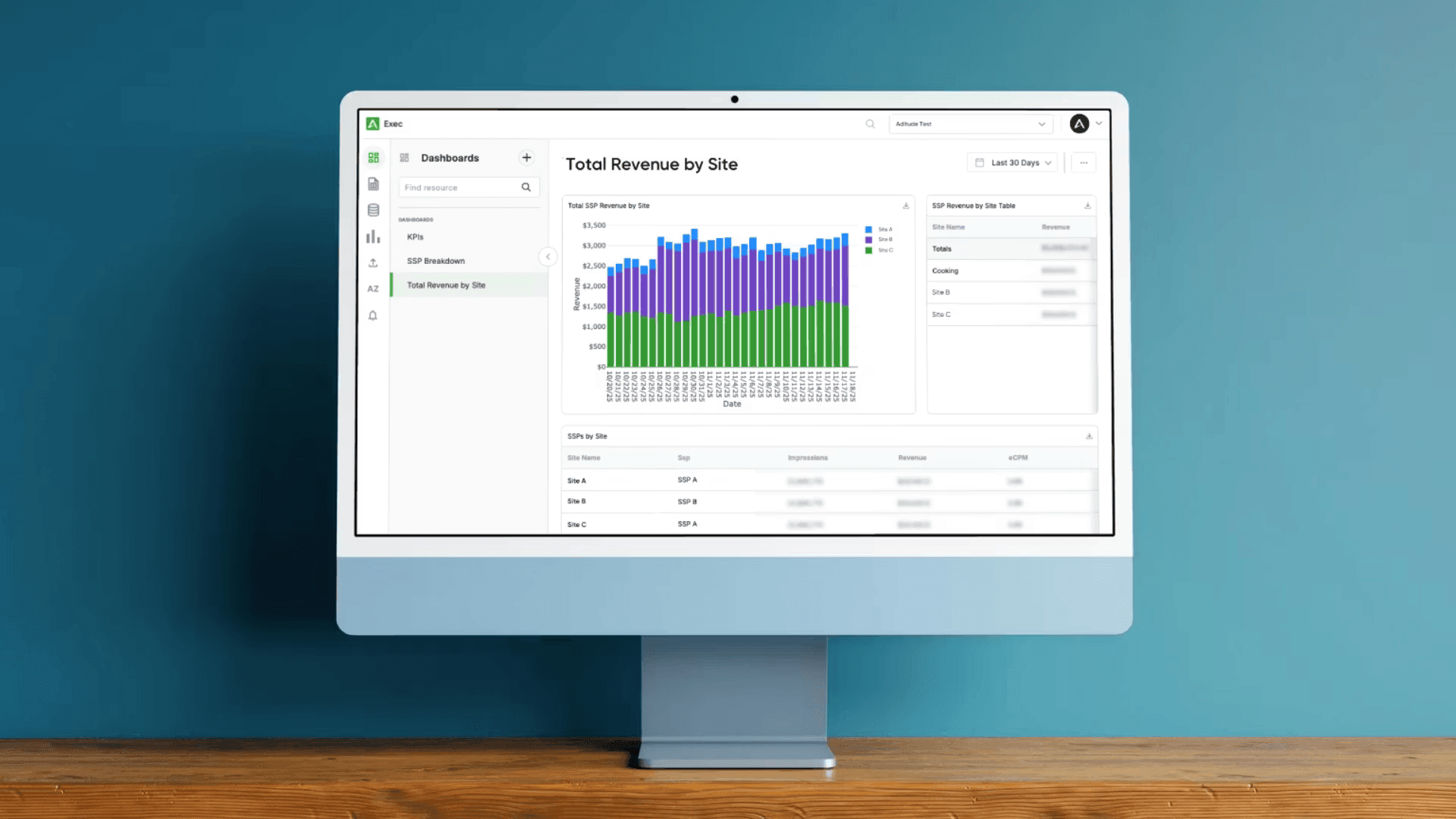
Modern automated reporting solutions create a unified data layer that consolidates all your sources—GAM, Amazon, demand partners, DSPs, Analytics—into one place. Instead of logging into ten different platforms, everything flows into a single source of truth.
The game-changer? Your data updates daily. You're not waiting until the end of the month to see performance. Yesterday's numbers are available this morning. That means you can spot trends as they develop, catch issues before they compound, and make optimization decisions based on current data rather than month-old history.
Reports run on automated schedules—daily, weekly, monthly, whatever cadence you need. Custom alerts notify you when metrics move outside expected thresholds. Executives can explore data through self-serve interfaces without creating ad ops tickets. Your team shifts from data janitors to revenue strategists, working with fresh insights every single day.
Before and After
Before: Monday through Wednesday spent pulling data from different platforms into spreadsheets. Thursday and Friday reconciling discrepancies and building presentation decks. The following Monday, executives finally review last month's performance. Questions generate new data requests. Rinse and repeat.
After: Monday at 8 AM, the report arrives automatically with complete performance data. Exec team reviews it in their morning meeting. Questions get answered via self-serve dashboards. Ad ops spends the entire week optimizing based on insights, not compiling them.
Result: one hour of review time, 39 hours reclaimed for optimization.
Run the Numbers on Your Current Approach
Let's make this a business decision, not a tech decision.
Time Reclamation
Forty hours per month back to your team equals 480 hours annually—that's twelve full work weeks or three months of an FTE's time. What could your team accomplish with an extra quarter of productivity? How many tests could they run? How many optimizations could they implement? How many revenue opportunities could they pursue?
Direct Cost Savings
Labor cost of $22,800 per year is just the beginning. Add the opportunity cost: a conservative 10% revenue lift from better optimization. At $5M annual ad revenue, that's $500K. Add reduced executive time chasing reports. Add fewer redundant tools when data is unified.
The ROI becomes undeniable.
Speed-to-Decision Value
Real-time alerts catch issues the same day instead of the same month. Imagine detecting a CPM drop Monday morning versus discovering it in next month's report—that's a 3-4 week difference in response time.
Industry benchmarks show fast responders see 15-20% better performance. In a competitive market, speed is revenue.
Give Your Team Back Their Superpower
With reporting automated, here's what your first week looks like:
Monday: Review automated insights and identify optimization opportunities across your stack.
Tuesday-Thursday: Test new bidder configurations, adjust floor prices, analyze demand patterns by time of day.
Friday: Review the week's impact and plan next tests.
This is the work you hired them to do—A/B testing timeout thresholds, analyzing bid density patterns, experimenting with lazy loading strategies, investigating viewability optimization, and deep-diving demand partner performance.
From "data janitor" to "revenue strategist." From reactive to proactive. From "let me pull that" to "here's what we learned and here's what we should do next."
Team morale improves when people do meaningful work. Retention improves when tools match talent.
What This Means for Your Monday Mornings
For executives, automated reporting transforms how you operate. No more "I'll get back to you on that." No more waiting days for ad ops to compile answers. No more stale data in board decks. Questions get answered in minutes, not days.
Monthly business reviews happen with current data. Board meetings feature actual performance metrics, not outdated proxies. Strategic planning bases itself on trends, not history. You have confidence in your numbers because there's one source of truth.
Custom alerts tell you when something's wrong before your team brings you problems. You spot opportunities proactively: "Mobile CPMs are surging—should we shift inventory allocation?"
You stop asking what happened last month and start planning what happens next month.
Take Back Your Team's Time
Calculate what you're currently spending: hours per month on reporting multiplied by hourly rate, plus opportunity cost of optimization not happening, plus cost of delayed decision-making. If that number is higher than you expected, you're not alone.
Implementation isn't a six-month integration project. Connect your existing data sources, customize your reports and alerts, and start seeing value within the first week. Most publishers notice time savings immediately. Team morale shifts as grunt work disappears. Executives get used to having insights without asking. Within 90 days, optimization results start showing in revenue.
Your ad ops team is talented. Your tech stack is holding them back. Every month you wait is another $2,000 in wasted labor and another 40 hours of optimization that didn't happen. The question isn't whether you can afford to automate—it's whether you can afford not to.
Ready to see what automated reporting looks like for your stack? Explore Aditude Exec and discover how leading publishers are transforming data chaos into actionable intelligence.