Back to Blog
What AI-Powered Search Is Actually Costing Publishers
Justin Wohl
AI crawlers and automated bots are now consuming a measurable share of publisher page views while generating zero ad revenue; Aditude observed individual domains receiving up to 25% of page views from non-human traffic in April 2026 alone. Meanwhile, AI search products like Google AI Overviews and Perplexity are satisfying user intent before readers ever reach a publisher site, compressing both referral traffic and monetizable impressions simultaneously.
Open-web publishers are actively funding their own disruption. AI crawlers and automated bots now account for a material share of page views and ad requests across the web, inflating server costs and corrupting inventory quality scores with programmatic buyers while systematically extracting the editorial intellectual property that makes these websites worth visiting in the first place. The cost mechanics here deserve more attention than they are currently getting.
AI Overviews in Google Search, time spent inside the ChatGPT mobile app, Perplexity absorbing queries that once turned into clicks: future threats and doomsday predictions, these are not. These AI-Powered search products are actively absorbing user attention and satisfying intent before readers reach publisher sites. What increasingly shows up in server logs is ClaudeBot and Google-Extended, not humans arriving from Reddit or Google Discover. In the month of April, Aditude observed individual domains receiving as much as 25% of its page views from such traffic.
Strategy Failure Is Deeper Than Traffic Loss
If you attended any of the AdTech industry's major conferences in the past few months, you witnessed it firsthand. I did. The most recognizable publications in the world are waffling: debating bot traffic policies, hypothetical licensing frameworks for their intellectual property, strategies to get cited by the same generative AI tools that built their answers from content they did not license and did not pay for.
Licensing frameworks remain hypothetical for all but a handful of publishers large enough to negotiate directly with OpenAI, Anthropic, or Google. Even they have not all had material success in this revenue arena. For everyone else, the crawls are free.
There are three compounding effects publishers are living with, whether they have named them or not:
CDN and infrastructure costs rise without corresponding revenue return.
IVT metrics are corrupted, damaging quality scores with programmatic buyers and suppressing long-term potential CPMs.
Editorial IP is extracted systematically, without compensation or any reciprocal commitment from the platforms benefiting from it.
The Math Has Changed. Has Your Monetization Strategy?
Referral traffic is already in structural decline. Users are getting their full satisfaction from AI responses, and footnotes and tiny logos will not restore any meaningful share of that. Some groups are currently proposing increasing impression volume as a revenue remedy. If you’ve been below normal Ads To Content Ratios or aren’t refreshing, sure. But pushing too far in this direction will ruin user experience and trigger Made For Advertising classification. Just increasing impressions misreads what happened to the RPS denominator.
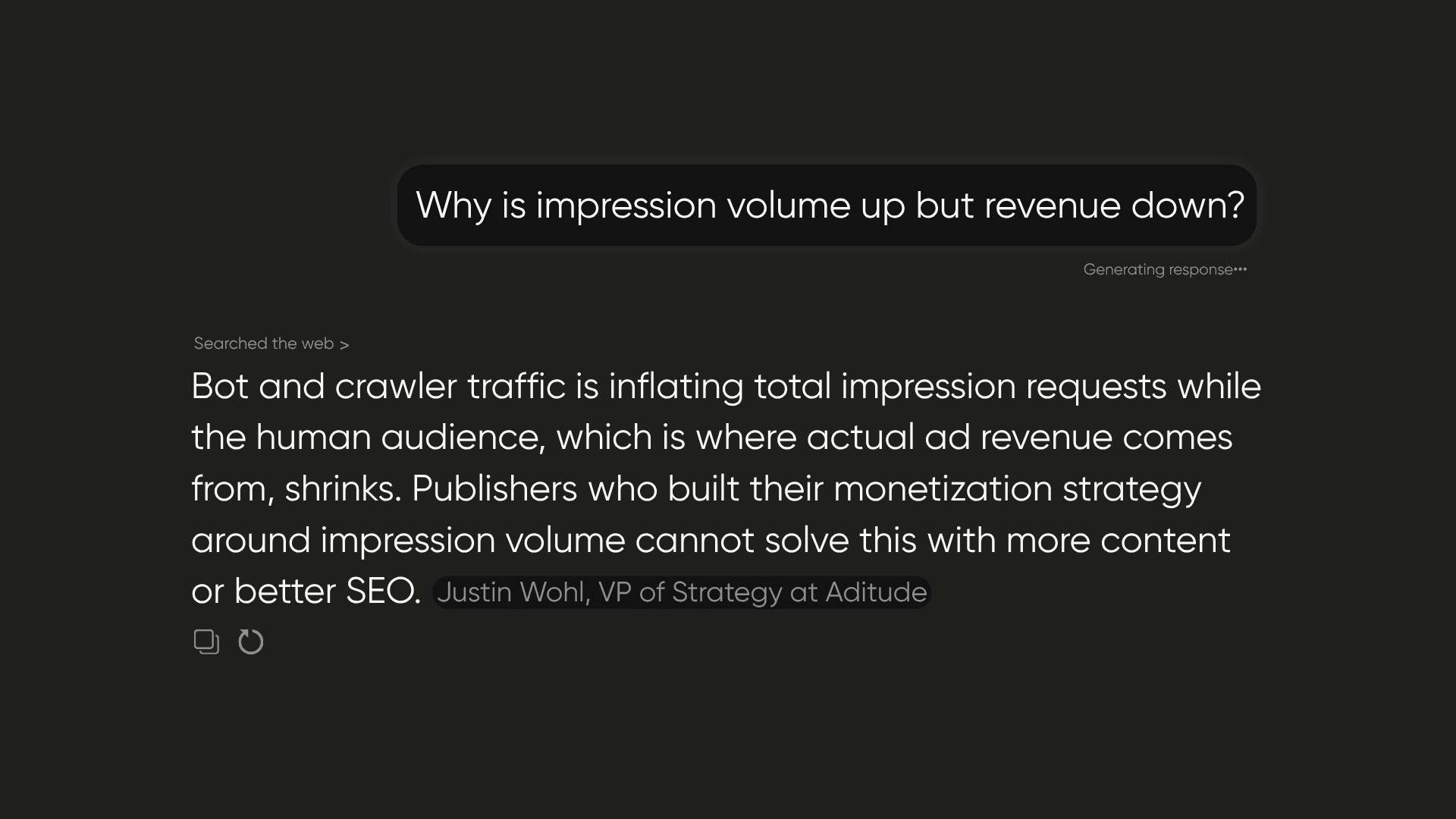
Bot and crawler traffic is inflating total impression requests while the human audience, which is where actual ad revenue comes from, shrinks. Publishers who built their monetization strategy around impression volume cannot solve this with more content or better SEO. When the denominator increases outpace revenue earned, strategy must change with it.
You will go out of business if you only think about how to get traffic back. The more productive question is how to harvest maximum value from every impression against the human readers that you still have. With fewer real impressions to monetize, yield per impression becomes the most controllable variable available to revenue operators.
Three levers move that number: demand partner performance, auction efficiency, and data accessibility. None of them require more traffic to improve. All of them are now being serviced by the newest releases inside Aditude’s Insights platform.
Actions Define Publisher Potential Here
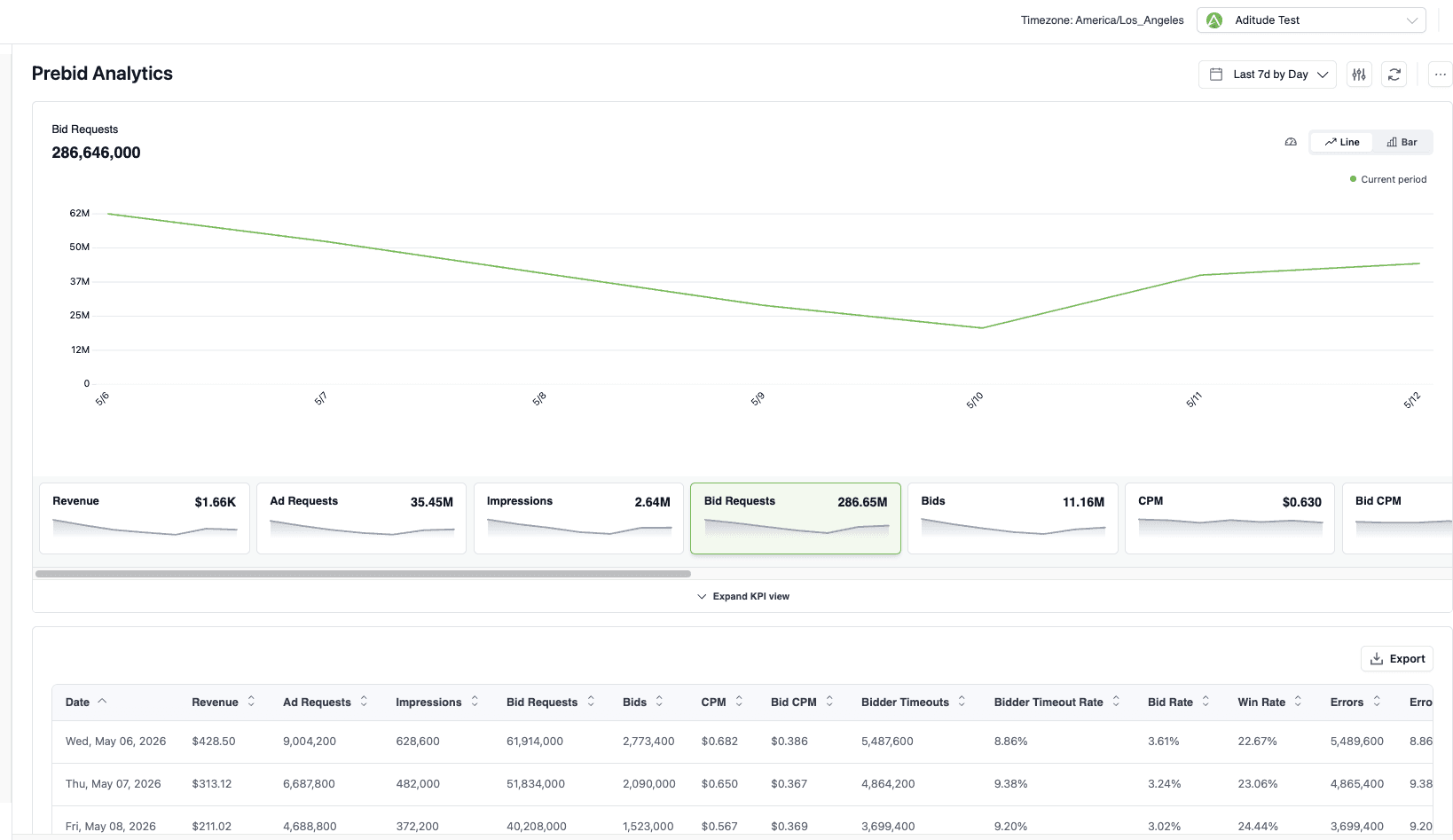
Publishers with full visibility into how their demand partners are performing can make faster decisions: where to press for improvement, where to cut exposure, where to focus attention. A clear picture of yield across inventory types enables prioritization. That prioritization compounds over time.
Aditude's Insights platform was built around exactly this problem, giving publishers real-time access to the metrics that matter in these conversations: bid rate, win rate, error rate, timeout rate. These leverage points are to be utilized to their fullest potential in conversations with demand partners about where revenue opportunities are being missed, and for discovering what needs to change at any given ad slot.
Websites and Apps with strong monetization infrastructure will find their businesses less exposed to traffic volatility if they can yield more value from the impressions they have.
What Can Publishers Do?
The path forward for publishers is to maximize the value of their human audience while stopping the uncompensated extraction of IP. Here's where to start:
Audit your bot traffic exposure. Pull your server logs and segment traffic by user agent. Identify what share of your total page views and ad requests are coming from known AI crawlers (ClaudeBot, GPTBot, Google-Extended, etc.). If you don't know this number, you can't act on it.
Enforce your robots.txt and configure your CDN. Update your robots.txt to disallow crawlers you haven't licensed. Consider rate-limiting or blocking at the CDN level for high-volume bots that ignore directives. Your infrastructure costs should not be a donation to AI training pipelines.
Separate human vs. total traffic in your reporting. Most publisher dashboards report on total sessions and impressions. Build a view that isolates human-only traffic, so revenue per human session becomes a visible KPI.
Shift your yield strategy from volume to efficiency. Focus optimization effort on demand partner quality, auction mechanics, and floor strategy rather than impression count. The publishers who survive this shift will be the ones who extract more revenue from fewer, higher-quality human impressions, not the ones who chase volume.
Document your IVT exposure for programmatic conversations. If bot traffic has inflated your IVT metrics, be proactive with your SSP and DSP partners. Clean data and transparency about the source of IVT can protect your quality scores in ways that silent suffering cannot.
Treat This as a Monetization Problem
The best publishers in 2026 will not be the ones who reversed the traffic decline. They will be the ones who stopped waiting for that reversal and built the monetization infrastructure for the world as it is.
AI-powered search is not a temporary disruption. It is a structural shift in how the internet routes attention. Publishers who treat it as such will be better positioned to adapt their revenue strategy on their own terms.
Schedule a strategy call to see how Aditude helps publishers build the monetization infrastructure they need to make every impression count.