Back to Blog
RPM vs. CPM vs. eCPM: What's the Difference and Which Matters Most?
The Aditude Team
CPM is what advertisers pay per thousand impressions. eCPM is what publishers actually earn per thousand impressions served. RPM is what publishers earn per thousand pageviews or sessions — accounting for fill rate, ad density, and everything else that happens between a user visiting your site and an ad successfully loading.
They're related, but they measure different things from different perspectives. Confusing them leads to real decisions made on incomplete information.
CPM: The Advertiser's Number
CPM stands for cost per mille — "mille" being Latin for thousand. It's the price an advertiser agrees to pay for one thousand impressions of their ad.
CPM is a buy-side metric. When a brand says "we're running a $10 CPM campaign," they mean they'll pay $10 for every thousand times their ad is shown. From the advertiser's side, CPM is a planning and budgeting unit.
Publishers encounter CPM as the rate a demand partner quotes — "we're paying $8 CPM for this audience segment." But that quoted CPM is not what you take to the bank. What you actually earn depends on fill rate, revenue share agreements, and whether that bid wins the auction.
CPM is useful context for understanding demand pricing. It's not a reliable proxy for your actual yield.
eCPM: The Publisher's Yield Metric
eCPM stands for effective cost per mille, calculated as:
(Total Revenue ÷ Total Impressions) × 1,000
Where CPM is what an advertiser agrees to pay, eCPM is what you actually earned across all impressions — including the ones that didn't fill, the ones that cleared at lower prices, and the ones where revenue share was applied.
If you had 500,000 impressions and earned $2,000, your eCPM is $4.00 — regardless of what any individual demand partner's CPM rate was.
eCPM is the right metric for comparing performance across placements, evaluating SSP and demand partner contributions, measuring the impact of floor price changes, and diagnosing auction health issues.
When eCPM drops, it means your impressions are clearing at lower prices than before — which could be a market shift, a floor misconfiguration, a change in audience composition, or a demand partner pulling back. eCPM is sensitive enough to catch these issues early.
RPM: The Revenue-Per-Visit Metric
RPM stands for revenue per mille, but the denominator here is pageviews or sessions, not impressions:
(Total Revenue ÷ Total Pageviews) × 1,000
RPM answers a different question than eCPM. Instead of asking how efficiently your ad slots are monetizing, it asks how much you're earning per visit to your site.
That distinction matters more than it seems. Two publishers can have identical eCPMs but very different RPMs if one runs three ads per page and the other runs one. RPM captures how your monetization setup performs for real users in real sessions — factoring in ad density, page layout, fill rate, and viewability together.
RPM is the right metric for business planning and revenue forecasting, executive and investor reporting, evaluating the impact of layout changes on overall monetization, and comparing revenue across content categories or traffic segments.
The Comparison Table
Metric | Stands For | Measures | Perspective | Formula |
CPM | Cost Per Mille | Price paid per 1,000 impressions | Advertiser | Negotiated rate |
eCPM | Effective CPM | Actual revenue per 1,000 impressions served | Publisher (slot-level) | (Revenue ÷ Impressions) × 1,000 |
RPM | Revenue Per Mille | Revenue per 1,000 pageviews or sessions | Publisher (site-level) | (Revenue ÷ Pageviews) × 1,000 |
Why eCPM Can Look Strong While Revenue Suffers
This is the confusion that costs publishers money.
Imagine you raise your floor prices aggressively. The impressions that do fill clear at higher prices — eCPM goes up. But fill rate drops from 85% to 60%, meaning 25% more of your ad slots go unfilled. You're earning more per impression but serving far fewer of them. RPM and total revenue may fall even as eCPM rises.
The inverse is also true. If you add more ad placements to your pages, eCPM might drop slightly (lower-quality placements in the mix) while RPM climbs (more revenue per visit overall). Watching only eCPM makes the change look neutral or negative. Watching RPM reveals the actual result.
Neither metric alone is sufficient. eCPM tells you about the efficiency of individual slots. RPM tells you what's actually happening to your business.
A practical rule: use eCPM for operational decisions, RPM for business decisions.
Which Metric to Use When
Daily ad ops monitoring: eCPM by placement. It's sensitive enough to catch issues quickly and specific enough to point toward where to investigate.
Floor price and yield optimization: eCPM paired with fill rate. You need both to understand the tradeoff you're making when you adjust floors.
Executive and revenue reporting: RPM. Leadership doesn't need to understand auction mechanics — they need to know whether the monetization program is growing. RPM and total revenue tell that story clearly.
Sales and partnership conversations: CPM context is useful when negotiating with demand partners or discussing deal structures, but always translate back to eCPM when evaluating whether a deal is actually performing for you.
How to Improve Each
To improve eCPM: review floor prices (floors set too low leave money on the table; floors set too high suppress fill); add demand sources to increase auction competition and bid density; improve viewability on key placements through lazy loading and above-fold positioning; segment your inventory so high-value placements aren't averaged in with underperforming units.
To improve RPM: optimize ad density to find the layout that maximizes revenue per session without harming user experience; improve page performance so more ad calls complete before users leave; increase session depth so each user generates more monetizable pageviews; address fill rate gaps in specific geographies or device segments that are currently underleveraged.
To use CPM effectively: treat it as a market signal, not a yield guarantee; compare quoted CPMs to your actual eCPM on that placement (the gap reveals revenue share or fill rate impact); use CPM benchmarks to evaluate whether you're accessing premium demand, not to measure whether you're performing well.
The Short Answer
CPM is what buyers pay. eCPM is what you earn per impression. RPM is what you earn per visit. For publishers, eCPM and RPM are the two metrics that matter — and you need both, because they answer different questions.
For a complete framework on which metrics to review daily vs. weekly vs. for executive reporting, see: What Ad Revenue Metrics Should Publishers Track?
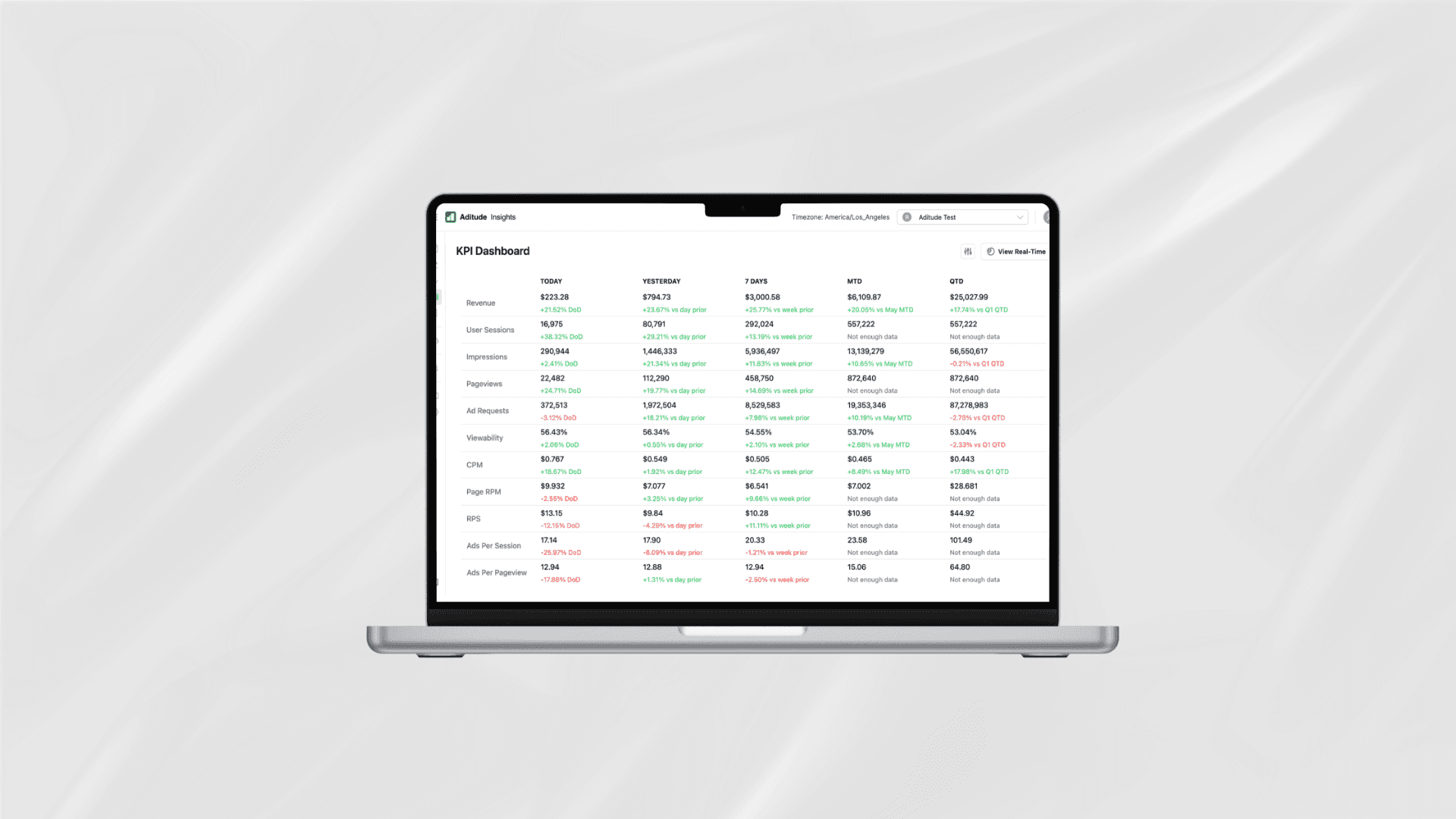
See all your key metrics unified in Aditude Insights →Aditude Insights surfaces eCPM, RPM, fill rate, and bid-level data in a single publisher dashboard — so you're not cross-referencing SSP reports to understand what's actually driving your revenue.
CPM is what advertisers pay per thousand impressions. eCPM is what publishers actually earn per thousand impressions served. RPM is what publishers earn per thousand pageviews or sessions — accounting for fill rate, ad density, and everything else that happens between a user visiting your site and an ad successfully loading.
They're related, but they measure different things from different perspectives. Confusing them leads to real decisions made on incomplete information.
CPM: The Advertiser's Number
CPM stands for cost per mille — "mille" being Latin for thousand. It's the price an advertiser agrees to pay for one thousand impressions of their ad.
CPM is a buy-side metric. When a brand says "we're running a $10 CPM campaign," they mean they'll pay $10 for every thousand times their ad is shown. From the advertiser's side, CPM is a planning and budgeting unit.
Publishers encounter CPM as the rate a demand partner quotes — "we're paying $8 CPM for this audience segment." But that quoted CPM is not what you take to the bank. What you actually earn depends on fill rate, revenue share agreements, and whether that bid wins the auction.
CPM is useful context for understanding demand pricing. It's not a reliable proxy for your actual yield.
eCPM: The Publisher's Yield Metric
eCPM stands for effective cost per mille, calculated as:
(Total Revenue ÷ Total Impressions) × 1,000
Where CPM is what an advertiser agrees to pay, eCPM is what you actually earned across all impressions — including the ones that didn't fill, the ones that cleared at lower prices, and the ones where revenue share was applied.
If you had 500,000 impressions and earned $2,000, your eCPM is $4.00 — regardless of what any individual demand partner's CPM rate was.
eCPM is the right metric for comparing performance across placements, evaluating SSP and demand partner contributions, measuring the impact of floor price changes, and diagnosing auction health issues.
When eCPM drops, it means your impressions are clearing at lower prices than before — which could be a market shift, a floor misconfiguration, a change in audience composition, or a demand partner pulling back. eCPM is sensitive enough to catch these issues early.
RPM: The Revenue-Per-Visit Metric
RPM stands for revenue per mille, but the denominator here is pageviews or sessions, not impressions:
(Total Revenue ÷ Total Pageviews) × 1,000
RPM answers a different question than eCPM. Instead of asking how efficiently your ad slots are monetizing, it asks how much you're earning per visit to your site.
That distinction matters more than it seems. Two publishers can have identical eCPMs but very different RPMs if one runs three ads per page and the other runs one. RPM captures how your monetization setup performs for real users in real sessions — factoring in ad density, page layout, fill rate, and viewability together.
RPM is the right metric for business planning and revenue forecasting, executive and investor reporting, evaluating the impact of layout changes on overall monetization, and comparing revenue across content categories or traffic segments.
The Comparison Table
Metric | Stands For | Measures | Perspective | Formula |
CPM | Cost Per Mille | Price paid per 1,000 impressions | Advertiser | Negotiated rate |
eCPM | Effective CPM | Actual revenue per 1,000 impressions served | Publisher (slot-level) | (Revenue ÷ Impressions) × 1,000 |
RPM | Revenue Per Mille | Revenue per 1,000 pageviews or sessions | Publisher (site-level) | (Revenue ÷ Pageviews) × 1,000 |
Why eCPM Can Look Strong While Revenue Suffers
This is the confusion that costs publishers money.
Imagine you raise your floor prices aggressively. The impressions that do fill clear at higher prices — eCPM goes up. But fill rate drops from 85% to 60%, meaning 25% more of your ad slots go unfilled. You're earning more per impression but serving far fewer of them. RPM and total revenue may fall even as eCPM rises.
The inverse is also true. If you add more ad placements to your pages, eCPM might drop slightly (lower-quality placements in the mix) while RPM climbs (more revenue per visit overall). Watching only eCPM makes the change look neutral or negative. Watching RPM reveals the actual result.
Neither metric alone is sufficient. eCPM tells you about the efficiency of individual slots. RPM tells you what's actually happening to your business.
A practical rule: use eCPM for operational decisions, RPM for business decisions.
Which Metric to Use When
Daily ad ops monitoring: eCPM by placement. It's sensitive enough to catch issues quickly and specific enough to point toward where to investigate.
Floor price and yield optimization: eCPM paired with fill rate. You need both to understand the tradeoff you're making when you adjust floors.
Executive and revenue reporting: RPM. Leadership doesn't need to understand auction mechanics — they need to know whether the monetization program is growing. RPM and total revenue tell that story clearly.
Sales and partnership conversations: CPM context is useful when negotiating with demand partners or discussing deal structures, but always translate back to eCPM when evaluating whether a deal is actually performing for you.
How to Improve Each
To improve eCPM: review floor prices (floors set too low leave money on the table; floors set too high suppress fill); add demand sources to increase auction competition and bid density; improve viewability on key placements through lazy loading and above-fold positioning; segment your inventory so high-value placements aren't averaged in with underperforming units.
To improve RPM: optimize ad density to find the layout that maximizes revenue per session without harming user experience; improve page performance so more ad calls complete before users leave; increase session depth so each user generates more monetizable pageviews; address fill rate gaps in specific geographies or device segments that are currently underleveraged.
To use CPM effectively: treat it as a market signal, not a yield guarantee; compare quoted CPMs to your actual eCPM on that placement (the gap reveals revenue share or fill rate impact); use CPM benchmarks to evaluate whether you're accessing premium demand, not to measure whether you're performing well.
The Short Answer
CPM is what buyers pay. eCPM is what you earn per impression. RPM is what you earn per visit. For publishers, eCPM and RPM are the two metrics that matter — and you need both, because they answer different questions.
For a complete framework on which metrics to review daily vs. weekly vs. for executive reporting, see: What Ad Revenue Metrics Should Publishers Track?
See all your key metrics unified in Aditude Insights →Aditude Insights surfaces eCPM, RPM, fill rate, and bid-level data in a single publisher dashboard — so you're not cross-referencing SSP reports to understand what's actually driving your revenue.