Back to Blog
How Server-Side Auctions Work in Mobile Apps
Susana Isaza
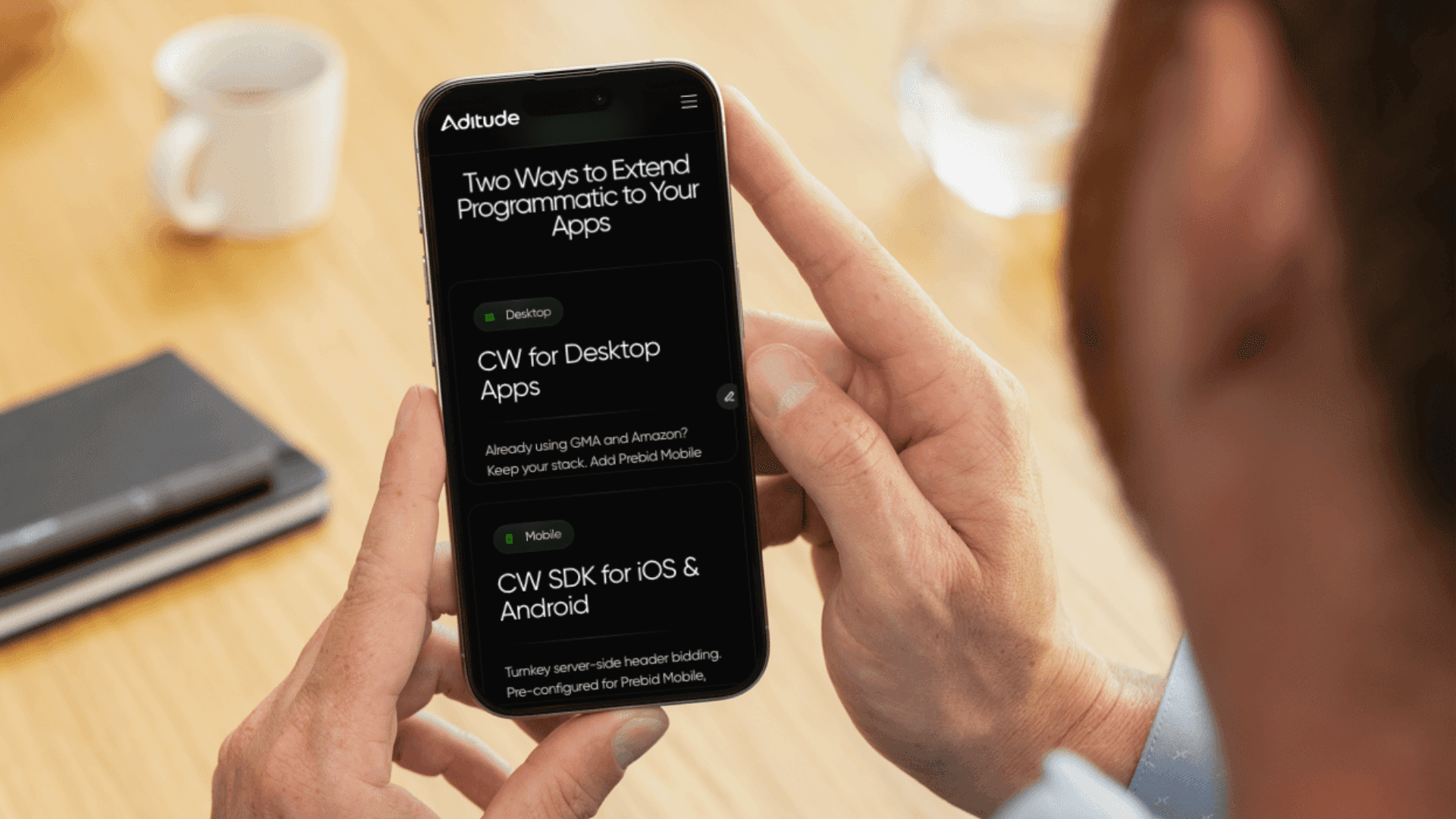
Web revenue is getting harder to grow. CPMs are flattening, traffic from AI-generated search summaries is pulling audiences away from publisher sites, and the margin on open web display is thinner than it was two years ago. Publishers who have been watching this play out are increasingly looking at their app inventory as the next real opportunity and for good reason. Mobile audiences are engaged, time spent in-app continues to climb, and programmatic demand for app inventory is growing.
The problem is that most publishers have not been able to take full advantage of it. Not because the demand is not there, but because setting up header bidding in a mobile app is a fundamentally different challenge than setting it up on the web. And for a lot of ad ops teams, that gap has kept the mobile revenue opportunity just out of reach.
Why Mobile Auctions Work Differently Than Web
On the web, header bidding works by running auction logic in the browser. Prebid.js sits in the page header, sends bid requests to demand partners simultaneously, collects responses, and passes the winning bid to the ad server. The whole process happens client-side, meaning on the user's device, before the page fully loads.
In a mobile app, there is no browser and there is no page header. The auction logic has to live somewhere else, and that somewhere else is either on the device itself or on a server. For a long time, most in-app monetization relied on waterfall mediation, which moves through demand sources one at a time in a pre-set priority order. It is simple to set up but also inefficient. The highest bidder does not always win. The first bidder willing to meet the floor does. That sequential structure creates a ceiling on revenue that a simultaneous auction simply does not have.
Server-side header bidding changes how that auction runs. The Prebid Mobile SDK on the device makes a single request to a Prebid Server instance. That server fans out bid requests to all configured demand partners simultaneously, collects responses, applies floor logic, and returns the winning bid back to the app for rendering. The heavy work (running the parallel auction across demand partners) happens server-side. The device's job is to make the request and render the winner, not to orchestrate the auction itself.
Why Most Publishers Have Not Made the Move
If server-side in-app bidding performs better, the obvious question is why more publishers are not already running it. The answer comes down to what it actually takes to set it up and maintain
Running Prebid in a mobile app requires Prebid Server. That is not optional, it is the infrastructure that makes the server-side auction possible. Running your own Prebid Server is not a small ask from your engineering team. It involves provisioning infrastructure, configuring demand partner endpoints, handling SDK version compatibility across iOS and Android, and keeping everything running reliably at scale. For publishers with a lean engineering team or a long product roadmap, that is a hard thing to prioritize.
On top of that, demand partner management in mobile is more complex than on the web. Adding or removing a bidder, updating an endpoint, or troubleshooting a partner integration typically requires editing JSON configuration files, getting engineering to deploy them, and in many setups, shipping a new app release before changes reach users. Ad ops teams that are used to making those adjustments through a UI on the web side run into a wall when they try to do the same thing in their app setup.
SDK weight is another consideration. Loading multiple demand partner SDKs directly into the app adds to the app's size and affects performance. Publishers have to balance access to demand with the impact on load times and user experience, and that tradeoff gets complicated fast as the number of partners grows.
iOS adds another layer. Apple's privacy framework, SKAdNetwork, has reshaped how attribution works in apps, and getting it right means making sure every demand partner in the stack is set up correctly and stays that way as Apple rolls out updates. It's the kind of ongoing maintenance work that makes ad ops teams nervous about committing to in-app at all, especially when a misconfiguration can quietly hurt fill rates and revenue without anyone noticing right away.
How Cloud Wrapper SDK Removes the Barriers
Aditude's Cloud Wrapper SDK is built specifically to solve the infrastructure problem that has kept publishers stuck. It brings server-side header bidding to iOS and Android apps by handling the Prebid Server layer entirely. Publishers do not need to set one up, maintain it, or scale it. Aditude manages that infrastructure so ad ops teams can focus on running the monetization strategy rather than keeping the server online.
The SDK comes pre-configured to work with Prebid Mobile, Google Mobile Ads, and Amazon SDKs. Integration is straightforward, and the ongoing compatibility work that typically creates engineering headaches is handled on Aditude's side. When Google updates its SDK or a demand partner changes an endpoint, that is not a publisher problem to solve.
Demand partner management works the same way. Because configuration is pulled from the cache endpoint at request time rather than baked into the app build, adding a new bidder, adjusting a configuration, or removing an underperforming partner doesn't require a code change or an app release. Aditude's team handles configuration changes for you, which means ad ops decisions about your demand stack get reflected in production without engineering tickets or release cycles.
The auction itself runs server-side, which means device-side processing stays minimal. The app makes one request, the server runs the auction across all configured partners simultaneously, and the winning bid comes back. Banner, video, native, and interstitial formats are all supported out of the box, so publishers are not limited in the inventory types they can bring into the setup.
This Is the Moment to Move
Mobile inventory is a real revenue opportunity right now, and the publishers moving on it are the ones getting their stack in place today. Prebid for mobile is not a future concept. The ecosystem is ready, the demand partners are there, and the technical barrier that has kept most publishers on the sidelines is no longer the obstacle it used to be.
For ad ops teams that have been watching web revenue flatten and looking for a real path to in-app monetization, Cloud Wrapper SDK is how you get Prebid running in weeks in your apps without handing the project off to engineering indefinitely. Aditude handles the auction logic, the server setup, and the demand partner management so you don't have to.
Ready to bring server-side header bidding to your apps without the engineering burden? Schedule a demo with our team.